
Firefighter Psych Test (2025): Psychological & Personality Assessment Guide

1. Introduction: Understanding the Firefighter Psych Test
Becoming a firefighter in Australia isn’t just about fitness, aptitude test, or interview performance. One of the biggest hurdles candidates face and one of the least understood is the psychological and personality assessment. FRV, QFD, Fire & Rescue NSW examples below.
This stage stops a huge number of applicants every year, often not because they’re unsuitable, but because they don’t understand what’s being measured or how the psych test works.
This guide gives you a clear, practical breakdown of:
- Introduction to firefighter psychological testing
-
What the firefighter psych test actually is – video
-
What it measures
-
The traits Australian fire services look for and why
-
What makes people fail – Common Mistakes
-
Real sample questions
-
How the test is scored & Red Flags – video
- How the psych test differs between FRV, QFES/QFD, FRNSW and other states
-
How to prepare the right way
Whether you’re applying for FRV, QFES/QFD, Fire & Rescue NSW, ACT Fire & Rescue, SAMFS or DFES WA Fire and Emergency Services, this guide will help you understand exactly what to expect.
2. What Is the Firefighter Psych Test?
The firefighter psych test (sometimes called a psychological assessment, personality inventory or work styles) is a structured evaluation designed to assess:
-
Your behavioural tendencies
-
How you respond under pressure
-
Your decision-making style
-
Your emotional stability
-
Your suitability for a high-risk team environment
Most services use:
-
Personality questionnaires
-
Situational Judgement Tests (SJTs)
-
Validity/consistency scales
-
Follow-up interview-style psychological screening (in some states)
The goal isn’t to “trick you.”
It’s to identify whether your behavioural traits match those of successful firefighters.
Video: why fire services use personality and psych tests
If you want a deeper dive into why fire services use personality and psych tests in recruitment, this video breaks it down step by step.
3. What the Test Measures (Key Firefighting Traits)
Different fire services use different tools, but ALL of them measure a similar group of core attributes and personality models:
Key Traits
-
Conscientiousness – following rules, reliability, safety discipline
-
Team Orientation – working closely with others under stress
-
Emotional Control – staying calm, maintaining judgement
-
Stress Tolerance – functioning reliably under pressure
-
Impulse Control – avoiding risk-taking behaviour
-
Situational Judgement – making effective decisions
-
Communication Style – clarity, respectfulness, listening
-
Adaptability – handling change, feedback and uncertain situations
These traits are mapped closely to what the service providers have formulated that a firefighter need to demonstrate in emergency situations as well as being in line with the likelihood that you will fit in and foster organisational values.
4. Types of Firefighter Psych Tests Used in Australia
Most services use a mix of the following:
1. Personality Questionnaires
Likert-scale items such as:
-
“I prefer to plan ahead rather than be spontaneous.”
-
“People often describe me as calm under pressure.”
2. Situational Judgement Tests (SJTs)
Short scenarios with multiple decision options.
3. Behavioural Consistency Scales
Detects contradictions or random responding.
4. Psychological Screening Interview (varies by state)
Some states include a follow-up interview with a psychologist to discuss your results. In this type of interview they will use all the data points they have collected throughout your application in order to formulate the interview style and questions.
5. Common firefighter psych test types and providers
Across Australian fire services you’ll see different brands and formats of psych tests.
Some of the more common ones we help people with include:
- Emotional intelligence tests (Emotify, MSCEIT)
- Hudson psychometric tests – business attitudes, work styles and reasoning
- Work Safety / Work Behaviour inventories
- Keirsey Temperament Sorter
- Personality Factors questionnaires
- NEO Personality Inventory (NEO PI-R / NEO-FFI)
- OPQ – Occupational Personality Questionnaire
- Pearson VUE psych and aptitude suites
If you want a deeper breakdown of all these test types, including real case studies, scoring examples, and insider strategies, you’ll find it inside my firefighter book bundle: “Inside Personality Profiling: How To Beat The Firefighter Psych Tests”
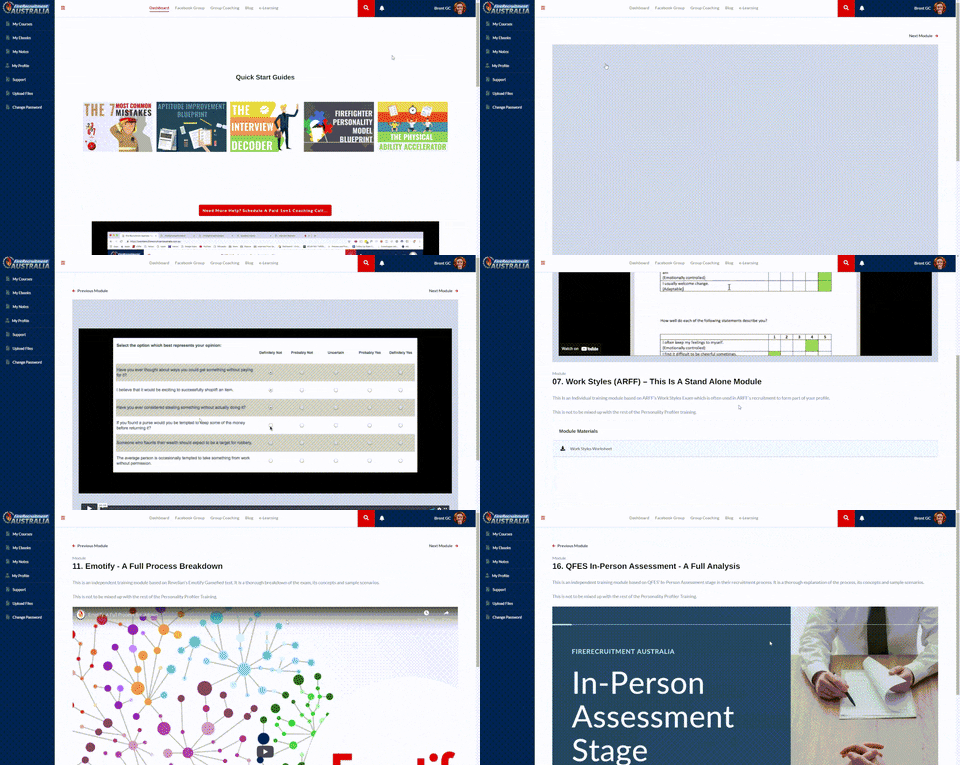
We’ve built training around the main test providers used by FRV, QFES/QFD, FRNSW and other services so you can see exactly what to expect before you sit them.
Most applicants don’t know which tool their agency uses until the day they receive the link. The good news is that nearly all of them measure the same core traits, and the preparation strategies taught inside the FRA Membership work across all major test providers.
5. Sample Questions (Personality + SJT Examples)
Here are realistic psychological test example items taken from patterns across currently used psych tests:
Personality Statement Examples
Rate from “Strongly Agree” to “Strongly Disagree”:
-
“I remain calm in chaotic situations.”
-
“I pay close attention to details.”
-
“I prefer working in a team rather than alone.”
-
“I think carefully before reacting in stressful circumstances.”
-
“People often rely on me to stay composed.”
SJT – Psychological Test Example
Scenario:
You arrive on scene and notice a team member is visibly flustered and making poor decisions.
Which response is most appropriate?
A) Give them orders to follow and take control
B) Ignore it and focus on your own task
C) Calmly check in with them, clarify the task and redistribute workload if required (Best)
D) Mention their performance after the job is complete
6. Mistakes That Cause People to Fail
These are the most common errors made in psychological testing:
1. Trying to “game the test”
Inconsistent answers → automatic red flags.
2. Overthinking every question
This creates contradictions that signal instability or lack of clarity.
3. Extreme responding
Overuse of “Strongly Agree/Disagree” when nuance is expected.
4. Personality masking
Writing what you think a firefighter “should be” can result in mismatched patterns and inconsistency.
5. Rushing the test
Fast responding can trigger invalid scores. This is more easily measured now with some of the more advanced testing platforms similar to the cognify test or emotify.
6. Ignoring instructions
This should be an easy one to get right but a lot of people mess it up and it is an automatic suitability concern for obvious reasons.
7. Believing rumours and generic advice
When people don’t understand something, rumours spread fast. Psych tests are no different.
You’ll hear all sorts of advice about how to “beat” the test or that you should “just be yourself,
no preparation required”.
The problem is a lot of this advice is either incomplete or flat-out wrong.
Recruiters will often downplay the psych test and give very little detail about what’s used or how it’s scored. That secrecy
increases your anxiety and can actually hurt your performance.
You don’t need to game the test, but you also don’t want to walk in blind. Understanding what’s being
measured and how questions are structured lets you emphasise your strengths and avoid obvious pitfalls without faking your personality.
8. Not understanding pattern-based consistency checks
Many applicants don’t realise how often the same theme appears throughout the psych test.
These aren’t random – they’re intentional consistency checks.
For example, you may notice questions like:
-
“A morning exercise routine is the best way for me to get in shape. True or False.”
-
“I make time every ______ to exercise. A) Morning B) Afternoon C) Evening.”
-
“The best way to describe my fitness plan is a strict early morning routine.”
All refer to the same idea.
If your answers line up, even if you answer “B) Afternoon” on one and “False” on the others the examiner process sees that you’re answering honestly and consistently.
If your answers contradict each other for no logical reason, the system flags instability or “trying to present yourself too favourably.”
This type of psych test is long on purpose
This type of firefighter psych tests last 2+ hours and include hundreds of items.
This is intentional.
It wears down short-term memory of earlier answers, making inconsistency easier to spot.
Tip:
Be well-rested, well-fed, and mentally prepared — it’s a marathon, not a quick quiz.
7. How the Test Is Scored
Psychological tests use statistical models to identify:
1. Consistency Over Time
Your answers should follow a logical behavioural pattern.
2. Validity Scales
Detect:
-
Random responding
-
Social desirability bias
-
Inconsistencies
-
Contradictory traits
3. Suitability Indicators
Your profile is compared to patterns of successful firefighters.
4. Red Flags
-
Extreme impulsivity
-
Emotional volatility
-
Low stress tolerance
-
Poor teamwork tendencies
-
Rule-breaking patterns
Video: How red flags and scoring patterns actually work
In this video, our organisational psychologist walks through real examples of how answers are scored and where red flags appear.
Scoring is not about being “perfect.”
It’s about being consistent, stable, and suitable for risk-based teamwork.
Video: How To Achieve the (85–93 Sweet Spot) in Firefighter Psych tests
This in-depth scoring breakdown is one of the most valuable psych test resources you’ll ever watch.
In this video, our organisational psychologist explains:
• Why scoring between 85–93 is the ideal range
• How “extreme” responses trigger red flags
• How reverse-coded questions work
• How to avoid invalidation
• How exam designers build questions
• How your score is compared to thousands of applicants
8. Agency Differences in Psychological Testing
Different states use similar tools but with slightly different emphasis.
FRV (Victoria) Psychological Assessment
FRV recruitment uses a structured psych assessment which includes:
-
Personality questionnaire
-
SJT-style judgement assessment
-
Follow-up psychological review (if required)
-
Suitability scoring against FRV behavioural standards
See a full explanation of the frv firefighter psych test in this video:
QLD / QFES / QFD Psychological Assessment
Full Detailed QLD psychological assessment
Queensland uses:
-
Behavioural and personality testing
-
Assessment of emergency role suitability
-
Consistency and validity scoring
-
Key traits specific to QFES culture (team cohesion, safety, adaptability)
Queensland applicants often report:
-
Tougher emphasis on emotional stability
-
Deeper focus on team-fit indicators
Fire & Rescue NSW Psychological Assessment
FRNSW uses:
-
Personality inventories
-
Psychological screening interview
-
Assessments of situational judgement
-
Evaluation of behavioural alignment with FRNSW values
WA / ACT Psychological Screening (Short)
These jurisdictions use variations of SJT + personality inventories.
Short summary paragraphs only. For more detail around these check for updated training inside the membership area
9. How to Prepare for the Psych Test (Your CTA Section)
1. Practice realistic questions
Use personality + SJT formats.
2. Avoid trying to be “perfect”
Fire services want stable, consistent humans — not actors.
3. Focus on real traits
Especially stress tolerance, teamwork, impulse control.
4. Understand the role
Stress, danger, teamwork, consistency, professionalism — everything is evaluated.
5. Use guided prep if needed
We’ve helped hundreds of applicants understand and prepare for the psych component — reducing “unknowns” and increasing confidence. If you want to make sure you can pass the psych test and get hired get more details here
10. FAQs
Is the firefighter psych test hard?
Only if you don’t understand what it measures. With proper guidance, most applicants perform well.
Can the psych test disqualify me?
Yes. Certain behavioural patterns can be unsuitable for high-risk emergency roles. What can make this particularly bad for you as an applicant is if you post an unsuitable profile this can sometimes stay on your application record without disqualifying you from applying again meaning you have a potential black mark you need to overcome on the next application without you having any knowledge of it.
Are all firefighter psych tests the same?
No principles are similar, but each agency uses its own tools. One thing to remember is that it’s all in the detail, we are looking to accumulate as many 1% advantages as possible and the psych test is a huge opportunity to do this.
How long does the psych test take?
Between 30–90 minutes depending on the agency and tools used.
How do I prepare?
Understand the traits, use this article (most people won’t), avoid overthinking, get help and practice realistic scenarios.
Conclusion
We definitely have more things to look forward to here at Fire Recruitment Australia as we work towards upgrading our tools and programs so we can help you better prepare despite the current situation. For relevant review materials needed for your Testing Preparations, you can visit our Firefighting Aptitude test Page.
For further assistance, feel free to speak with us.
Cheers,
Brent
P.S. Whenever you’re ready… here are 4 ways we can help you Get The Edge over the competition

